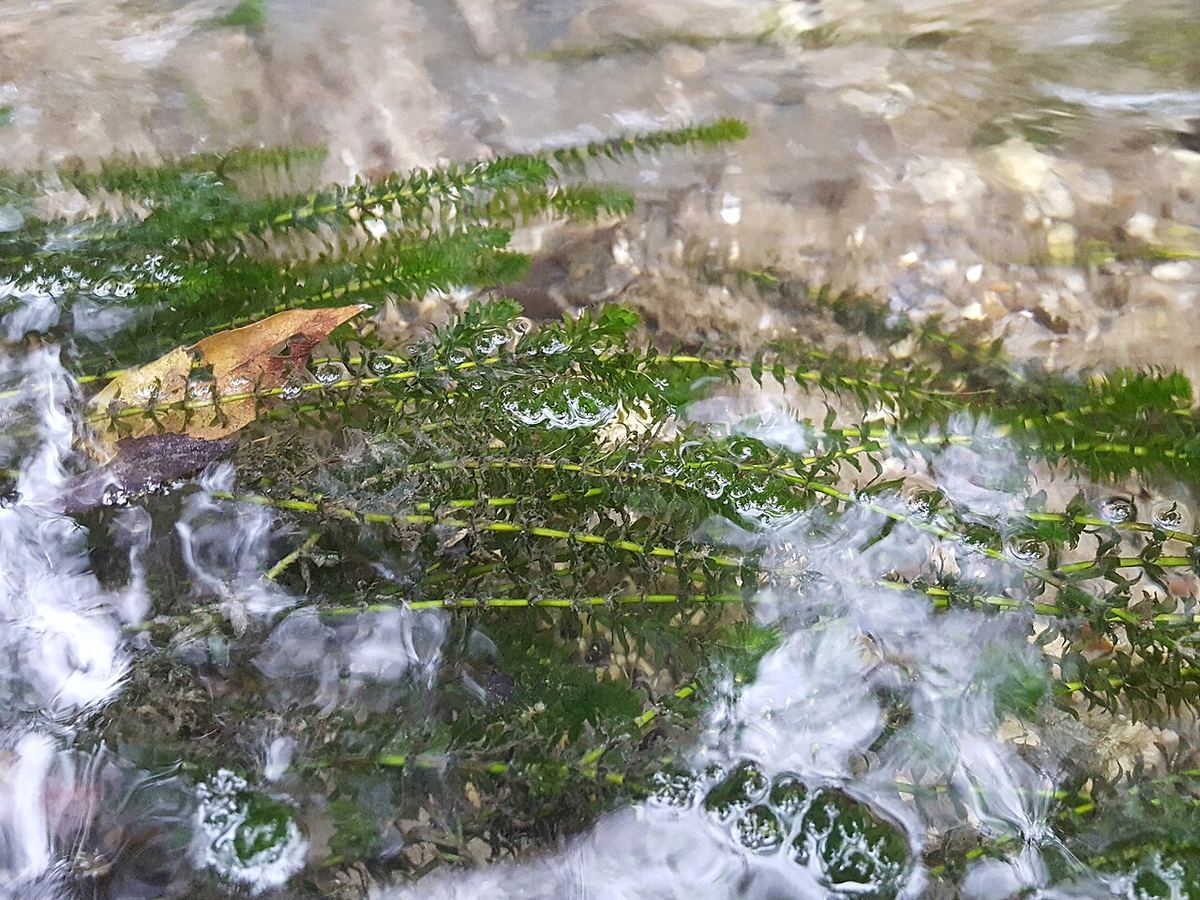
Photo: Alex Abair, CC BY 4.0, resized.
Quick Summary: Lake Austin hydrilla is at a near-record footprint in 2026, and the honest answer for buyers is that it is a manageable, well-understood problem, not a reason to cross the lake off your list. The City of Austin is using the same tool that cleared the lake completely in 2014, sterile grass carp, and stocking them more carefully this time. Some stretches are dense and others are nearly clear, so where a property sits matters more than the lake-wide headline. Owners can clear their own dock and swim areas under a Texas Parks and Wildlife permit, and the cost of doing so is small next to what buyers deduct when they see a choked dock. Our team lived through the same problem on Lake McQueeney in the 1990s, and that lake has been clear for nearly thirty years.
If you are looking at Lake Austin homes for sale this year, you will hear about hydrilla. Some of what you hear will be accurate, some of it will be a boater venting after a prop full of weeds, and very little of it will tell you what it means for the specific property you are considering. This post covers what hydrilla is, where Lake Austin hydrilla stands as of September 2026, what the city is doing about it, what we have seen at the dock on recent showings, what an owner can do, and how to think about it as a buyer or a seller.
What Hydrilla Is
Hydrilla is a non-native submerged plant that roots in the lake bottom and grows toward the surface, where it forms dense mats. In small amounts it does what any aquatic plant does: it holds fish, produces oxygen, and soaks up excess nutrients. In large amounts it clogs boat props and lifts, makes swimming unpleasant, crowds out native plants, and can degrade water quality. It spreads from fragments, which is why cutting it without removing it can make things worse, and why the "clean, drain, and dry" rule for boats and trailers matters on every Texas lake.
Where Lake Austin Hydrilla Stands in 2026
Texas Parks and Wildlife surveyed the lake in February and again in June 2026. The February survey found 592 acres of hydrilla and 58 acres of Eurasian watermilfoil, roughly 37 percent of the lake. The June survey found 575 acres of hydrilla and 75 acres of milfoil, so the combined footprint held about even through the first half of the summer (City of Austin Watershed Protection, September 2026).
The lake-wide number hides the part that matters to a buyer. Per the June 2026 survey map, the upper five miles from Mansfield Dam down to Lake Austin Spa Resort are dense from bank to bank. The middle stretch from Commons Ford Park to Emma Long Metropolitan Park has little hydrilla, with small patches of milfoil along the banks. Coverage declined around Ski Shores and grew where Bull Creek enters the lake, and in the lower lake it expanded inside Bee Creek Cove. Two properties a few miles apart can have completely different water in front of them.
How the Lake Got Here
Hydrilla is not new to Lake Austin. Between 1999 and 2003 it covered about an eighth of the lake, and the city began stocking sterile grass carp in 2003 to control it. The drought of 2010 to 2013 pushed growth faster than the carp could eat, and the city ramped up stocking in 2011 to keep pace (City of Austin Watershed Protection and KUT, August 2026).
That worked, and then it kept working. By 2014 the carp had eaten every acre of hydrilla, and with nothing else to eat they moved on to the native plants until those were gone too. The lake spent close to a decade with almost no aquatic vegetation, which the city's own memo describes as a cascade of problems: more algae blooms, less fish habitat, a collapsed fishery, and poorer water quality. Native plants began returning around 2022, and hydrilla returned with them. The city attributes the sudden spread in the summer of 2025 to a combination of nutrients carried in by the July 2025 floods, warm water, low flows through the lake because that floodwater was held upstream, and fertilizer washing off shoreline lawns (City of Austin Watershed Protection, September 2026).
Two things worth taking from that history. First, the tool works. Grass carp did not just control hydrilla on this lake; they eliminated it. Second, the city knows exactly what overstocking costs, which is why the current program is deliberately slower than the last one.
What the City Is Doing, and Why It Is Not Spraying
Sterile grass carp are the primary long-term tool. The city released nearly 2,000 in November 2025 and another 2,790 in May 2026 near Tom Miller and Mansfield Dams, raising the population from about five fish per acre of hydrilla to about eight. Based on the lake's history, the city considers roughly 5,000 fish a safe total as long as there is enough hydrilla to feed them, and it expects to request another stocking this fall once the next survey shows how growth is trending. The city is clear that results will not be immediate; the goal is sustained progress over several seasons (City of Austin Watershed Protection, September 2026).
Aquatic herbicides are not allowed on Lake Austin. The lake supplies two of Austin's major drinking water treatment plants plus smaller intakes, and it is narrow enough that chemicals applied in one spot can move downstream into those intakes. Drawdowns do not control hydrilla either; the roots survive and the plant comes back. The city's recommendation for shoreline owners is mechanical removal around docks and swim areas, done by the owner or by a contractor holding a Texas Parks and Wildlife permit. You can read the full picture on the City of Austin's Lake Austin page, including the current survey map.
What We Saw on Lake McQueeney
Hunter Croan, our owner, grew up on Lake McQueeney and was in high school when hydrilla took it over in the mid-1990s. The wide, shallow, mud-bottomed part of the lake grew so thick that from the water it looked like an island had appeared in the middle. The deeper river channel stayed largely clear. The lake was still boatable, but if your boathouse sat in a shallow section and you did not stay on top of it, getting a boat in and out of the slip was a real chore. Hunter and a friend started a hydrilla removal service, pulling it by hand and with lake rakes for neighbors who wanted their slips open.
At its peak, hydrilla covered more than half of Lake McQueeney. In May 1996 the lake received a whole-lake herbicide treatment, and in June 1996 the Guadalupe-Blanco River Authority and Texas Parks and Wildlife stocked 5,000 sterile grass carp there and another 5,000 in Lake Dunlap. The combination cleared the lake fast, and it stayed clear. Texas Parks and Wildlife kept surveying the lake for a return in the years that followed, and roughly five to seven years ago a GBRA employee told Hunter directly that small patches found on the lake had been spot-treated before they could spread. That is the part of the McQueeney story worth copying: keep watching, and deal with it while it is small. Nearly thirty years later hydrilla has not come back as a lake-wide problem, and the lake still carries plenty of native vegetation and a healthy fishery. If you want a lake where this story has fully played out, look at Lake McQueeney homes for sale.
Lake Austin cannot copy that playbook exactly, because the herbicide half is off the table on a drinking water reservoir. But the carp half is the same tool, it has already worked on this lake once, and it is in the water now.
What It Looks Like at the Dock: Three Recent Showings
Billy Stephens, one of our Highland Lakes specialists, recently walked lifelong Austin residents through homes on the north end of the lake near Mansfield Dam, where the water is normally the clear, cold water people picture when they think about jumping off a dock on a hot afternoon. At one property they stepped onto the dock and stopped. The hydrilla was so thick around the slips that using the boat lifts looked like a challenge, and nobody was going to swim there. The house was not the problem. The water was, and it was the deciding factor when they compared it with the other homes they had seen.
Billy's second story is the seller side of the same lesson. A prospective seller with a modest home and a good dock called him about listing. When Billy walked down to the water, hydrilla had completely taken over the area around the boat. He explained that a listing lives or dies on first impressions and that the dock area had to be cleared before the first photo was taken. Billy's estimate for the cleanup was under $10,000 (September 2026). The owner declined, listed with another agent, and by Billy's read the home is now priced about $200,000 below where it could have been if the hydrilla had been cleared.
Brooke LeMond recently sold a home with Lake Austin access near Greenshores, in the middle stretch the survey map shows as mostly clear. One of the things the buyer loved most was the community dock area: clear water, no hydrilla, the kind of spot where you can swim, sit by the water, or hop in the boat and go. Brooke's point is that having lake access is one thing, and how you can actually use it is what you are paying for. She also notes that some Lake Austin boaters have moved their boats over to Lake Travis for the season to skip the issue entirely.
What a Property Owner Can Do
Lake Austin is public water, so clearing hydrilla is regulated by the Texas Parks and Wildlife Department. A lakefront owner can remove it from around their own dock and shoreline with an approved treatment proposal, provided the plants are bagged, fully dried, or composted before they leave the property, so that fragments do not spread. Anyone removing it for hire, or using a mechanical harvester, needs a TPWD aquatic vegetation removal permit. There is no fee for that permit on public water. Ask any contractor you hire to show you their permit; the city says the same.
In practice the local services fall into a few categories. Manual cutting clears the canopy quickly but the roots and tubers remain, so regrowth typically shows up within a few weeks in summer, which is why most companies offer a recurring maintenance plan through the growing season. Root pulling takes longer per visit and buys more time between visits. Bottom barriers, covered in the next section, keep a cleared area from growing back. Every one of these is chemical-free, because it has to be on this lake. If you need hydrilla removal, a barrier install, or any other boathouse or waterfront work, reach out to us for recommendations.
The city also asks shoreline owners to cut back on lawn fertilizer and to consider a strip of native plants along the water's edge, since runoff from lawns feeds the plant. And on every lake: clean, drain, and dry the boat and trailer before moving to another body of water.
Bottom Barriers: Keeping a Cleared Slip Clear
Cutting clears Lake Austin hydrilla for a few weeks. A bottom barrier, also called a benthic barrier or lake blanket, is how owners keep it from coming back. After the slip or swim area is cleared, a contractor lays a weighted mat directly on the lake bed over the problem area: the swim area, the boat lane, or the water around a lift. The mat blocks sunlight, so the tubers and fragments underneath cannot grow into a new stand. Field research on light-blocking barriers has found large reductions in hydrilla sprouting and growth, with denser materials working better. It works best laid over freshly cleared bottom, and permitting may be needed for the install.
A barrier is a long-term tool, not a permanent one, and the difference matters. Hydrilla tubers can stay alive in the sediment for more than four years, so the plant is still there under the mat, waiting; if the barrier is torn, lifted, or pulled up, it grows back from the same spot. Sediment also settles on top of the mat over time, and fragments drifting in from nearby beds can root in it. Gas from decaying plants can also billow a solid sheet off the bottom, which is why Texas Parks and Wildlife recommends semi-permeable material. On the upper lake, where hydrilla is dense from bank to bank, expect more upkeep than in the clearer middle stretch.
What a barrier changes is the job. Instead of cutting every few weeks through the summer, the owner has the mat inspected and swept on a schedule, which is a far smaller and more predictable cost. Keep a record of the install date, the material, the area covered, the contractor, and every cleaning. That record matters when it is time to sell.
What the Canceled Drawdown Means for Lake Austin Hydrilla
The City of Austin and LCRA had planned to lower Lake Austin about ten feet from October 12 through November 30, 2026. On September 24 the city canceled it, after businesses on the lake raised concerns about losing the fall wedding season, University of Texas football weekends, and Formula 1. LCRA offered December 1 through January 15 as an alternate window, but that ran into the same concerns over holiday business. Stakeholders asked for January and February instead, and LCRA no longer holds drawdowns in the cold winter months so its hydroelectric generators stay available to the Texas grid. No new date has been set (City of Austin and KUT, September 24 to 25, 2026).
For hydrilla, the cancellation changes less than it might seem. A drawdown would not have controlled the plant; it would only have made the lake bed around a dock easier to reach. The tools that work are the ones described above: the city's grass carp program across the lake, and mechanical removal or bottom barriers at the dock under a TPWD permit, all of which contractors do at normal lake level. The city has also stopped accepting the special drawdown exemption it created for dock and bulkhead work, so owners who already filed one should confirm its status with Austin Development Services before scheduling anything. Our Lake Austin drawdown update covers what the cancellation means for owners, buyers, and sellers.
What This Means for Buyers and Sellers
For buyers, hydrilla is a due diligence item, not a verdict on the lake. Ask where the property sits relative to the survey map. Walk to the end of the dock at the showing and look down. Ask the seller what maintenance the dock area has needed over the last two summers and who did it. If the dock has a bottom barrier, ask when it went in, who maintains it, and when it was last cleaned. A maintained barrier turns hydrilla from a constant battle into a known, manageable line item; a neglected one under a layer of silt is just another place for it to grow. Weigh a lift or swim area that needs seasonal clearing the same way you would weigh any other recurring maintenance item, and price it accordingly. And keep in mind that a property that shows poorly today because of a temporary condition can be an opportunity if the house and the location are right. Our post on costly lakefront buying mistakes covers the broader list of water-related items to check before you write an offer.
For sellers, the first showing starts with the listing photos, and buyers will notice the water before they notice the kitchen. If the dock area has hydrilla, clear it before the photographer arrives. The cost is small next to the discount buyers apply when they see a choked slip, and Billy's story above is what leaving it looks like. Clearing the slip and installing a bottom barrier keeps the dock area clean for as long as the home is on the market, not just on photo day, and handing the buyer the install and maintenance records gives them a plan instead of a question. With the fall 2026 drawdown canceled, the lake will be at its normal level for fall listing photos, so the dock area is the thing to get right.
Whether you are buying or selling, the value of working with an agent who knows this lake shows up right here. Some coves are prone to it and some are not, the permit path is not obvious, and the difference between a well-maintained dock area and a neglected one is worth real money on both sides of the table. Hunter built the team around exactly this kind of waterfront due diligence, and Billy and Brooke work Lake Austin, including the surrounding Tarrytown, Steiner Ranch, and West Lake Hills markets, week in and week out.
Lake Austin Real Estate FAQs
Is Lake Austin still usable with the hydrilla?
Yes. Boating, wake sports, and swimming continue across the lake, with the most impact in the upper five miles near Mansfield Dam and in a few coves such as Bee Creek and Bull Creek. The middle stretch between Commons Ford and Emma Long had little hydrilla as of the June 2026 survey. Conditions change through the season, so check the city's latest survey map and ask an agent who is on the lake regularly.
Will the hydrilla go away?
The city expects sustained progress rather than a quick fix. Grass carp cleared the lake completely between 2011 and 2014, and the current program uses the same fish at a more measured pace to avoid repeating the overshoot that stripped the lake of all vegetation for nearly a decade. A wet year with strong flows from Lake Travis can also help by flushing nutrients and uprooting plants, according to Texas Parks and Wildlife's district biologist (KUT, August 2026).
Can I treat the hydrilla in front of my Lake Austin home myself?
You can remove it mechanically around your own dock and shoreline with an approved TPWD treatment proposal, as long as you bag, dry, or compost the plants so fragments do not spread. Herbicides are not permitted on Lake Austin. Contractors need their own TPWD permit, and it is fair to ask to see it.
Will a bottom barrier get rid of hydrilla for good?
Not on its own. A barrier keeps a cleared swim area, boat lane, or lift area from growing back, but the tubers in the sediment underneath survive for years, and sediment that settles on top of the mat can grow new plants. Treat it as a long-term tool that needs regular inspection and cleaning, not a one-time fix. Permitting may be needed for the install.
Does hydrilla affect Lake Austin real estate values?
It affects individual properties more than the lake as a whole. A home in a clear stretch is unaffected. A home with a choked slip shows poorly and gets discounted until it is cleared, which usually costs a small fraction of that discount. Buyers should treat it as a maintenance line item and sellers should handle it before photos. Our post on how lake levels affect property values covers the other water-related factors that move waterfront pricing.
Is hydrilla a problem on Lake Travis too?
Lake Travis has not seen a comparable outbreak, and some Lake Austin boaters have moved their boats there for the season. The two lakes suit different buyers for reasons well beyond vegetation; our Lake Austin vs. Lake Travis comparison walks through the differences.
Which parts of Lake Austin have the least hydrilla?
Per the June 2026 Texas Parks and Wildlife survey, the middle stretch from Commons Ford Park to Emma Long Metropolitan Park had the least. That is a snapshot, not a guarantee, and conditions differ cove by cove and season by season. It is one reason we recommend a boat-side look at any property before you commit.
Talk to Our Lake Austin Specialists
Hydrilla is one of a dozen water-related questions that separate a good Lake Austin purchase from a regrettable one, and it is one we can answer property by property. Whether you are searching for Lake Austin waterfront lots, Lake Austin condos, or a lake house on the water, or you are preparing to sell and want the dock area handled before the first photo, The Lakefront Group can help. Call us at 830.253.5253, contact us online, or sign up for Lake House Alerts to see Lake Austin real estate as it comes available, including off-market opportunities.