
Quick Summary
Not every alke in Central Texas allows private boathouses, and the rules vary more than most buyers expect. Canyon Lake prohibits all private waterfront improvements under Army Corps of Engineers ownership. The lower Guadalupe Lakes allow permanent boathouses but typically require permitting into GBRA-managed lakebed. Lake Travis allows floating docks only due to significant water level fluctuations. On Lake LBJ and parts of the Highland Lakes, lakebed ownership can vary between LCRA and private parties, affecting what can be built and under what terms. Understanding these distinctions before you buy protects your lifestyle expectations and your investment.
One of the most common questions waterfront buyers ask before they start their search is this: can I have my own boathouse?
For many buyers, that answer shapes which lake makes sense. And across Central Texas, the answer is not the same on every lake.
In a recent Dock Talk discussion, Hunter Croan, founder of The Lakefront Group and a lifelong Central Texas waterfront resident, sat down with Hagan Cohle, Brooke LeMond, and Billy Stephens to cover exactly what is and is not allowed on the major Central Texas lakes. Here is what buyers need to know.
Canyon Lake: No Private Boathouses or Docks
If private waterfront access is a priority, Canyon Lake requires an important conversation before your search begins. Understanding Canyon Lake waterfront restrictions early can prevent buyers from pursuing properties that won't support their long-term boating goals.
Canyon Lake is managed by the U.S. Army Corps of Engineers, which owns the land surrounding the entire lake. No private boathouses, private docks, or permanent waterfront improvements of any kind are permitted. This applies to every property on the water, without exception.
What Canyon Lake does offer is public marina access, with one marina on the north side and one on the south, plus a Yacht Club. Hagan Cohle, the team’s buyer specialist for the Guadalupe Lakes and a lifelong New Braunfels resident, notes that virtually anywhere on Canyon Lake you are within about 15 minutes of a marina. For buyers who love the lake’s clear water and wide-open recreation, that works well.
For buyers who want to keep their boat at home, walk out the back door, and be on the water in minutes, Canyon Lake is not the right fit. One of the lower Guadalupe Lakes or the Highland Lakes will serve that lifestyle better.
Browse Canyon Lake waterfront homes to see what the lake offers within those parameters.
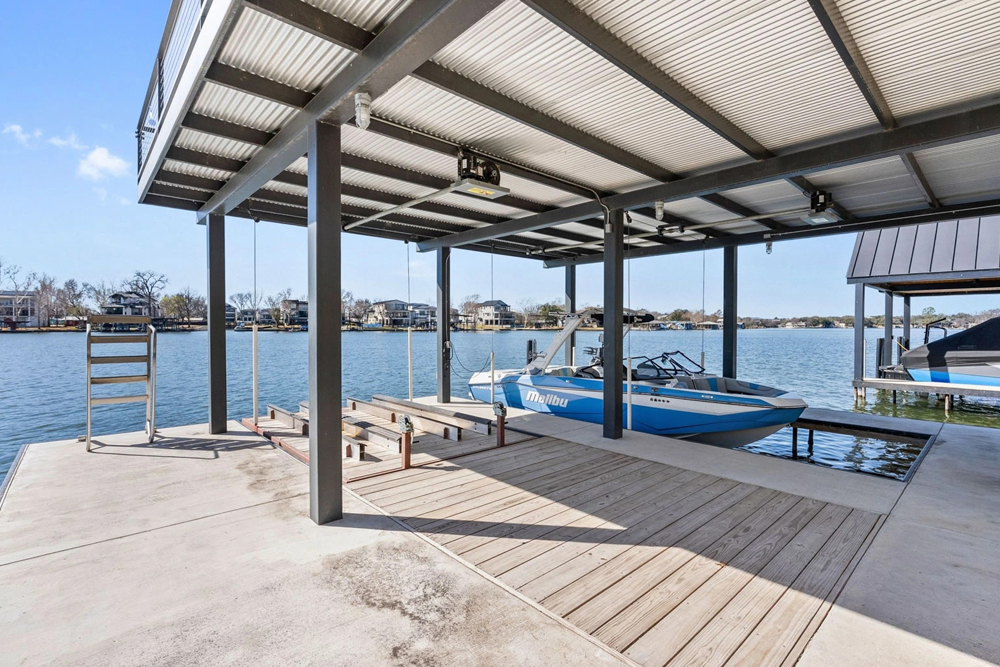
The Lower Guadalupe Lakes: Private Boathouses Allowed
Lake Dunlap, Lake McQueeney, Lake Placid, and Meadow Lake all allow private boathouses, permanent fixtures, and retaining walls. For buyers who prioritize convenience on the water, these lakes offer what Hagan describes as the “push button lifestyle,” where getting on and off the water takes minutes, not a trip to the marina.
That distinction matters significantly to buyers who are on the water regularly. It is also a real factor when comparing lifestyle and long-term value between Canyon Lake and the lower Guadalupe Lakes.
See current listings on Lake Dunlap, Lake McQueeney, Lake Placid, and Meadow Lake.
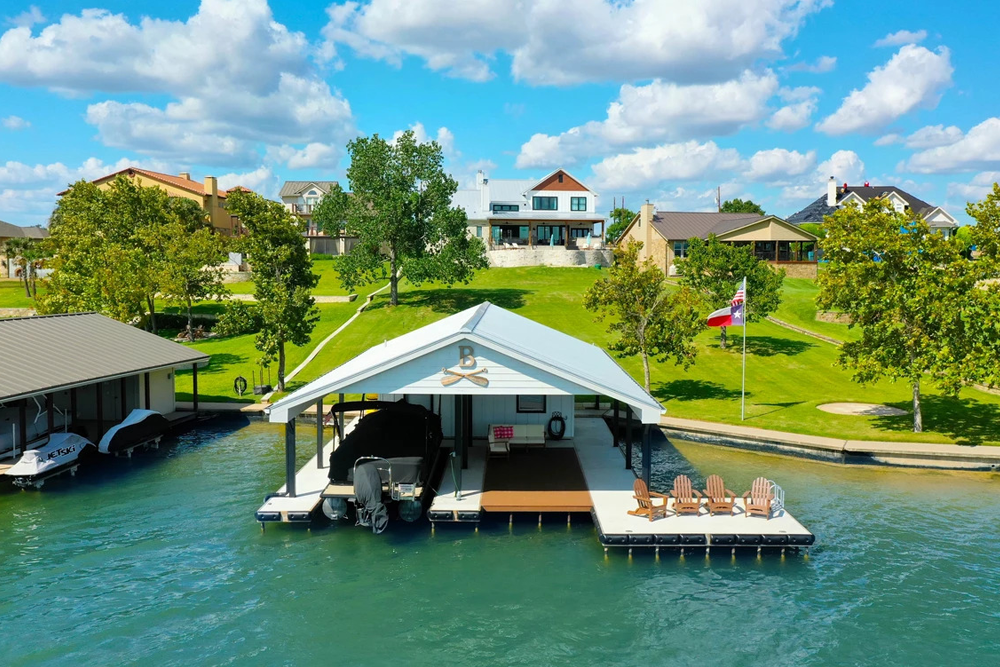
Building on the Lower Guadalupe Lakes: Understanding the Permitting Process
There is a detail that catches many buyers off guard on the lower Guadalupe Lakes: you do not always own all the way to the water’s edge. In many cases, the property ends before the shoreline, and waterfront improvements are built into lakebed managed by the Guadalupe-Blanco River Authority (GBRA).
That does not prevent you from having a boathouse. It means there is a permitting and engineering process involved. The Lakefront Group works regularly with experienced waterfront contractors, including NB Boathouse, who understand the GBRA requirements and know how to execute these builds correctly.
If you are purchasing a home that already has a boathouse on one of these lakes, it is worth confirming that the improvements were properly permitted. If you plan to add one after closing, knowing the process before you get there allows you to plan realistically and avoid surprises.
Lake Travis: Floating Docks Only
Lake Travis operates under a different set of realities, and it starts with water levels.
The lake can fluctuate by as much as 50 feet. These water-level changes are the primary reason boathouse rules Lake Travis buyers encounter differ significantly from those on more stable Central Texas lakes. A fixed dock that sits at a usable height at full pool becomes inaccessible during significant drought conditions. Because of this, floating docks are the standard on Lake Travis. Fixed docks are not something you will find there.
Brooke LeMond, who has sold Lake Travis waterfront throughout her career and spends meaningful personal time on the lake with her family, describes buying on Travis as partly a matter of knowing how to work with the water. Knowing exactly how far you own into the lake is an important piece of due diligence, because it determines how far a dock can extend and what improvements are practical.
Lakebed ownership on Travis is not uniform. Some properties carry ownership rights that extend well into the lake. In other cases, the lakebed is managed by the Lower Colorado River Authority (LCRA), which generally approves dock permits as long as they do not sit in active navigation areas. The Pedernales arm of the lake is one section where depth and lakebed conditions can require more planning before you build.
Browse Lake Travis waterfront homes and pay attention to what existing dock infrastructure looks like across different areas of the lake.
Lake Buchanan: A Mix of Fixed and Floating
Lake Buchanan, also managed by LCRA, sees a mix of dock types. Water levels on Buchanan can vary as well, making floating docks common. But unlike Travis, fixed structures do appear on parts of the lake, depending on location and lakebed conditions.
Browse Lake Buchanan waterfront homes for current inventory.
Lake LBJ and the Highland Lakes: Know Who Owns the Lakebed
On Lake LBJ and parts of the Highland Lakes, lakebed ownership is not the same from property to property. Billy Stephens, the team’s Highland Lakes and Rivers specialist whose background in building materials gives him practical insight into dock and boathouse construction costs, points out that what is known as fill property can vary significantly across these lakes. In some areas, LCRA or some private individual owns the lakebed which means that you or the seller need to acquire that property before building any improvements on land that you don’t actually own. . For a closer look at how lakebed boundaries work, see our guide to fill property on the Highland Lakes.
This is one of those details that separates buyers who close with a clear picture from those who discover limitations afterward. Lakebed ownership is not always prominently disclosed in listing materials, and not every agent working the Highland Lakes knows to ask about it upfront.
Explore Lake LBJ waterfront homes and make sure you are asking the right questions about waterfront access before closing.
What This Means for Buyers
Boathouse and dock access are not small lifestyle details. For many waterfront buyers, the ability to keep a boat at home, step out back, and be on the water without a second thought is central to why they are buying a lake house in the first place.
If that matters to you, make sure you are looking on the right lake. And if you plan to add a boathouse or dock to a property that does not currently have one, verify permitting requirements and lakebed ownership before you close, not after.
For more on what waterfront buyers commonly overlook, see our post on costly lakefront buying mistakes.
Work With Central Texas Waterfront Specialists
The Lakefront Group focuses exclusively on waterfront real estate across Central Texas. Hagan Cohle works with buyers throughout the Guadalupe Lakes region and can walk you through the specific dock rules, GBRA permitting process, and what private waterfront access actually looks like on Canyon Lake, Lake Dunlap, Lake McQueeney, and the surrounding lakes.
On the Highland Lakes side, Brooke LeMond and Billy Stephens bring firsthand knowledge of Lake Travis, Lake LBJ, Lake Buchanan, and the rest of the chain, including how dock access and lakebed ownership differ from property to property.
If a boathouse is a must-have or something you are planning to add, tell us that before we start. It determines which lakes make sense, which properties to focus on, and which questions need answers before closing. Our team specializes in Central Texas waterfront real estate and can help you evaluate dock access, permitting requirements, and waterfront ownership considerations before you buy.
Hunter Croan built this team specifically around Central Texas waterfront, which means questions about dock access, permitting, and lakebed ownership come up in nearly every transaction we handle.
Frequently Asked Questions
Can you have a private boathouse on Canyon Lake?
No. Canyon Lake is managed by the U.S. Army Corps of Engineers, which owns the surrounding land and does not allow private boathouses, docks, or permanent waterfront improvements of any kind. Canyon Lake does have public marina access on the north and south sides of the lake, as well as a Yacht Club, which serve residents who keep their boats nearby.
Which Central Texas lakes allow private boathouses?
The lower Guadalupe Lakes, including Lake Dunlap, Lake McQueeney, Lake Placid, and Meadow Lake, all allow private boathouses and permanent waterfront improvements. Most Highland Lakes also permit dock improvements, with details depending on lakebed ownership and applicable permitting requirements for each property.
Can you build a fixed dock on Lake Travis?
Fixed docks are not standard on Lake Travis. Because water levels can drop by 50 feet or more, fixed structures are not practical. Floating docks are the norm. If you are considering a Lake Travis purchase with dock access as a priority, confirm whether the property has existing permitted dock infrastructure in place.
What is fill property and why does it matter on Lake LBJ?
Fill property refers to modified or added lakebed, and on Lake LBJ and parts of the Highland Lakes, ownership of that underwater land is not consistent across properties. In some areas, LCRA owns the lakebed and issues dock permits. In others, a private party holds ownership, which affects what can be built and under what conditions. For more detail, see our guide to fill property on the Highland Lakes.
Do you need a permit to build a boathouse on Lake Dunlap or Lake McQueeney?
Yes. On the lower Guadalupe Lakes, many properties do not own all the way to the shoreline. Boathouses and docks are often built into GBRA-managed lakebed, which requires a permitting and engineering process. Working with a contractor who knows the GBRA requirements, such as NB Boathouse, makes that process significantly more manageable.
Does lakebed ownership affect what I can build?
Yes, and it is one of the more frequently overlooked pieces of due diligence in waterfront real estate. Whether the lakebed is managed by LCRA, GBRA, the Army Corps of Engineers, or a private party determines the permitting path and what improvements are allowed. This applies to lakes across both the Guadalupe and Highland regions, and it is worth verifying before you close on any waterfront property.
Whether you are searching for a property that already has a boathouse or planning to add one after closing, the right guidance makes a real difference. Reach out to The Lakefront Group to start your search with the right information from day one.
Posted by Hunter C on
Leave A Comment